Consciousness and Brain Communication | NOVA PBS Documentary
Uploaded by Neil Sargisian on October 23, 2026 at 7:41 pm
Consciousness and Brain Communication | NOVA PBS Documentary
What if your sense of self isn’t just in your head, but in the way different parts of your brain talk to each other? In the NOVA documentary "Your Brain Has Two Minds", scientists explore how consciousness emerges from brain communication—and how it can be lost and regained.
Consciousness is not a single process—it's a dynamic exchange between different brain regions. As the film puts it, "The split-brain phenomenon suggests that there can be two separated minds, if you will, inside of a skull." This insight reveals how fragile and distributed the experience of self actually is.
Neuroscience of Consciousness: How the Brain Creates Awareness
Neuroscience is the scientific study of the nervous system, and it plays a central role in understanding how the brain generates awareness. The film features insights from researchers like Emery Brown and Michael Gazzaniga, who have studied how anesthesia and split-brain conditions illuminate the relationship between brain communication and consciousness.
During anesthesia, the brain remains intact, but communication between regions is disrupted. Brainwave activity slows and becomes less complex. Anesthesiologists use EEG to monitor these changes, tracking the shift from conscious to unconscious states. When the patient wakes, brain communication resumes, and brainwave complexity increases. This shows that consciousness is not a fixed state but a process that can be suspended and reactivated.
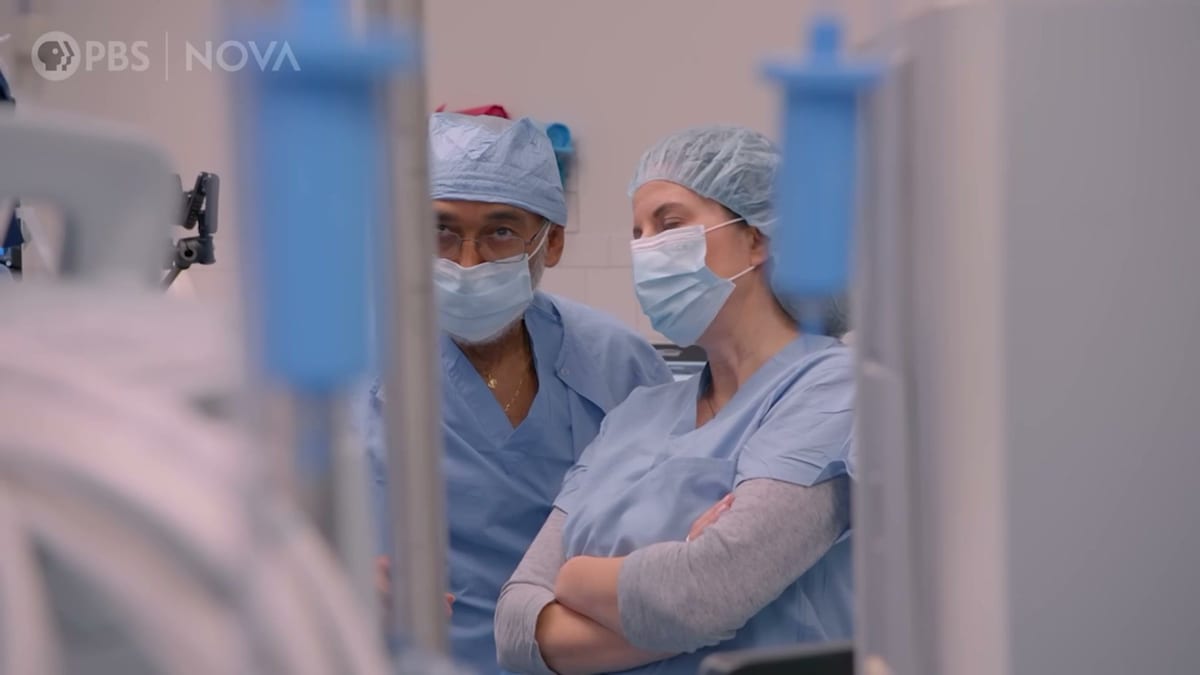
Medical professionals monitor a patient's recovery post-surgery, reflecting the complex brain activity as consciousness returns. (Still from the video by NOVA PBS Official.)
Split-Brain Patients and the Fragmented Self
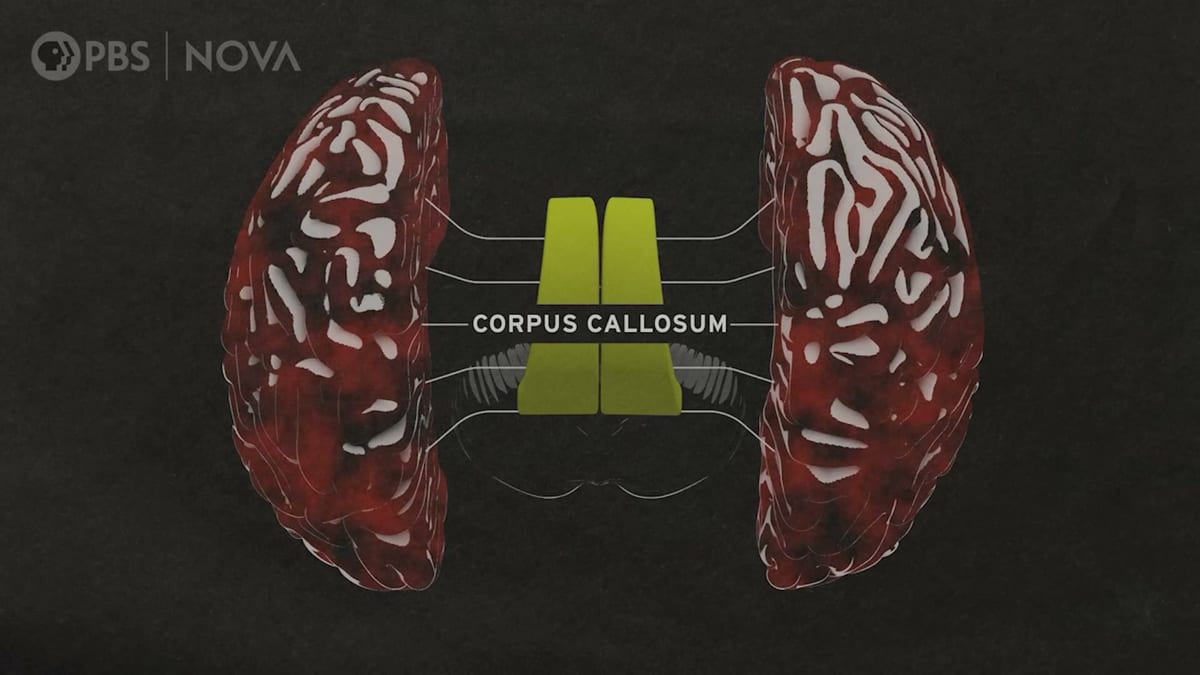
One of the most fascinating examples of brain communication affecting consciousness comes from split-brain patients. These individuals have had their corpus callosum—the main bridge connecting the two hemispheres—surgically severed. As a result, each hemisphere can function independently. In some experiments, one hemisphere controls movement while the other processes visual information without the ability to communicate. This can lead to situations where one side of the brain understands a word, but the verbal hemisphere remains unaware. The nonverbal hemisphere must then draw a symbol to express what it sees.
The corpus callosum, highlighted between the two hemispheres, is the bridge that carries communication from one side of the brain to the other. (Still from the video by NOVA PBS Official.)
This phenomenon suggests that the mind is not a singular entity but a network of interdependent processes. The documentary argues that communication between brain regions is what allows these processes to integrate into a unified experience of self. Without this integration, consciousness becomes fragmented.
NOVA PBS Official has long been at the forefront of making complex scientific ideas accessible to the public. This film continues that tradition by exploring not just the structure of the brain, but the emergent properties that define our sense of being. It’s a compelling look at how neuroscience is reshaping our understanding of consciousness and brain communication.
What if your sense of self isn’t just in your head, but in the way different parts of your brain talk to each other? In the NOVA documentary “Your Brain Has Two Minds”, scientists explore how consciousness emerges from brain communication—and how it can be lost and regained.
Consciousness is not a single process—it’s a dynamic exchange between different brain regions. As the film puts it, “The split-brain phenomenon suggests that there can be two separated minds, if you will, inside of a skull.” This insight reveals how fragile and distributed the experience of self actually is.
Neuroscience of Consciousness: How the Brain Creates Awareness
Neuroscience is the scientific study of the nervous system, and it plays a central role in understanding how the brain generates awareness. The film features insights from researchers like Emery Brown and Michael Gazzaniga, who have studied how anesthesia and split-brain conditions illuminate the relationship between brain communication and consciousness.
During anesthesia, the brain remains intact, but communication between regions is disrupted. Brainwave activity slows and becomes less complex. Anesthesiologists use EEG to monitor these changes, tracking the shift from conscious to unconscious states. When the patient wakes, brain communication resumes, and brainwave complexity increases. This shows that consciousness is not a fixed state but a process that can be suspended and reactivated.
Medical professionals monitor a patient’s recovery post-surgery, reflecting the complex brain activity as consciousness returns. (Still from the video by NOVA PBS Official.)
Split-Brain Patients and the Fragmented Self
One of the most fascinating examples of brain communication affecting consciousness comes from split-brain patients. These individuals have had their corpus callosum—the main bridge connecting the two hemispheres—surgically severed. As a result, each hemisphere can function independently. In some experiments, one hemisphere controls movement while the other processes visual information without the ability to communicate. This can lead to situations where one side of the brain understands a word, but the verbal hemisphere remains unaware. The nonverbal hemisphere must then draw a symbol to express what it sees.
The corpus callosum, highlighted between the two hemispheres, is the bridge that carries communication from one side of the brain to the other. (Still from the video by NOVA PBS Official.)
This phenomenon suggests that the mind is not a singular entity but a network of interdependent processes. The documentary argues that communication between brain regions is what allows these processes to integrate into a unified experience of self. Without this integration, consciousness becomes fragmented.
NOVA PBS Official has long been at the forefront of making complex scientific ideas accessible to the public. This film continues that tradition by exploring not just the structure of the brain, but the emergent properties that define our sense of being. It’s a compelling look at how neuroscience is reshaping our understanding of consciousness and brain communication.
Please consider donating. Our contributors depend on donations from viewers like you to keep our website alive. We're very grateful for even the smallest donations.








)
Comments