

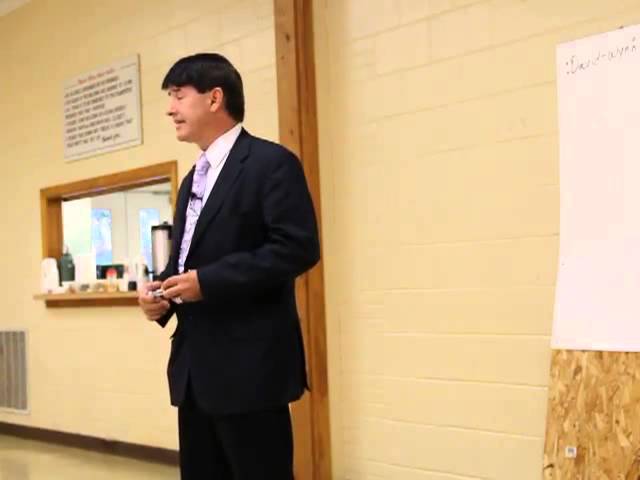






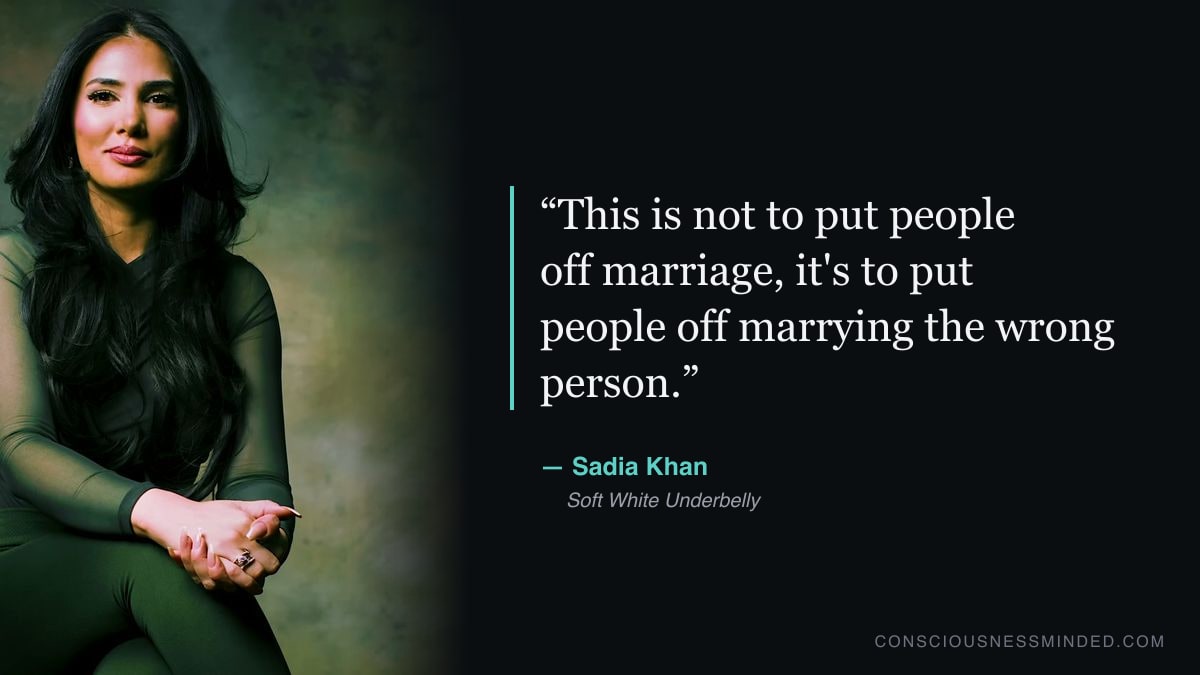


Sadia Khan is a psychologist who works in psychotherapy and relationship therapy, with a focus on trauma. In this Soft White Underbelly interview with Mark Laita, she makes a case that is easy to mishear. She is not against marriage. Instead, she is against marrying the wrong person.

Sadia Khan on Why So Many Marriages Fail
Laita opens with a blunt question about women who marry for money. From there, the talk widens to promiscuity, divorce and what both are doing to children. Khan’s answer is that the proof is in the statistics. In cultures where promiscuity is highest, she says, divorce rates, mental health problems and STDs are also at their highest.
Even so, Sadia Khan is clear about where she stands. “I’m a Muslim woman,” she says, and she calls herself “a big advocate for marriage”, above all for the sake of children. Her target is something else. In her view, poor selection is the only real cause when a marriage ends up in court. It is not the woman, and it is not the man. It is the choice they made at the start.
Technology, Courage and Desire
Next, Laita suggests that romance has never been harder. Men have pornography, women have sex toys, and everyone has millions of possible partners online. He argues that porn removes the courage it takes to approach someone in real life. Khan agrees, and she thinks men are suffering more from it.
She also traces how the media sexualizes children. Stars like Britney Spears and Miley Cyrus began with clean, child-friendly images. Then, almost overnight, they became hyper-sexualized, and their very young audiences were pulled along with them. As a result, Khan argues, many men now judge a woman mainly by her looks and how she performs sexually. Loyalty and kindness slide down the list.
She sees this regularly in Dubai, where she is based. A couple goes out to dinner, and she spends the meal on her phone while he worships her. In Khan’s reading, the woman knows it is purely physical. She is thinking, “I’m the best he’s ever had and therefore he’s not going anywhere.”
How Are You Using This Person? Sadia Khan Asks
Her most useful advice is one question to ask before any relationship begins: how am I using this person, and what for? Most of us use a partner for something, she says. For example, a new partner can be a numbing cream to get over an ex, or a way to feel stable when you have no money of your own. For an older man, a 27-year-old partner can be an ego boost, so people stare when he walks into a room.
However, some uses are healthy. “I’m using them because they make me feel safe,” is a good answer, especially when you make them feel safe in return. In other words, the honest question is not whether you need something from a partner. It is whether the need is healthy and shared.
Sadia Khan is just as frank about cheating. She says people use the phrase “emotional affair” to make themselves feel less guilty. “There’s no such thing as an emotional affair,” she says. She has close male friends she talks to every day, and that is not an affair.
Boundaries Start at Home
Boundaries, Khan says, matter in every relationship, not just romance. They usually start in childhood. Healthy parents can be strict, but they also notice a child’s emotions and respond to them. That carries into adult love. Even a partner who asks for everything, she says, is “still looking for the no”, because “somebody without boundaries is dangerous to us.”
Without boundaries, she warns, a relationship becomes “a slow divorce”. The split is coming, and the couple is only delaying it. She also notes how odd it seemed, growing up in London, that many teenagers moved out or paid their parents rent at 17 or 18.
What Schools Never Teach
Finally, Khan returns to education. Schools teach history, trigonometry and geometry, yet they rarely teach people how to relate to one another. “I used to be a psychology teacher for many years and I couldn’t believe that this isn’t compulsory,” she says. She taught children how childhood experiences and trauma shape development. Sadia Khan’s message, in the end, is a practical one. Choose carefully, know why you are choosing, and learn the skills that make love last.
Related on Consciousness Minded
- How IQ Levels Shape the Way We See the World
- The Secret to Lasting Love in Relationships | Eli J. Finkel | TED
- The Blueprint for Constructive Argumentation | Bo Seo on Debate and Democracy
About This Video
This video was created and published by Soft White Underbelly on YouTube. The commentary above is our own summary and context.
Want more insights on love, relationships, and modern psychology? Subscribe to Consciousness Minded and get the next deep conversation delivered to your inbox.



)
Comments